Popular Posts

Showing posts with label Physics. Show all posts

Monday, April 6, 2015

CERN restarts Large Hadron Collider, seeks dark universe

A general view of the Large Hadron Collider (LHC) experiment is seen during a media visit to the Organization for Nuclear Research (CERN) in the French village of Saint-Genis-Pouilly, near Geneva in Switzerland, July 23, 2014. 

GENEVA — Scientists at Europe’s physics research centre CERN yesterday (April 5) restarted their “Big Bang” Large Hadron Collider (LHC), embarking on a bid to probe into the “dark universe” they believe lies beyond the visible one.

CERN reported that particle beams were successfully pushed around the LHC in both directions after a two-year shut down for a major refit described as a Herculean task that doubled its power — and its reach into the unknown.

“It’s fantastic to see it going so well after such a major overhaul,” CERN Director General Rolf Heuer told delighted scientists and engineers as the beams moved round the tubes of the 27km underground complex.

Friday, November 22, 2013

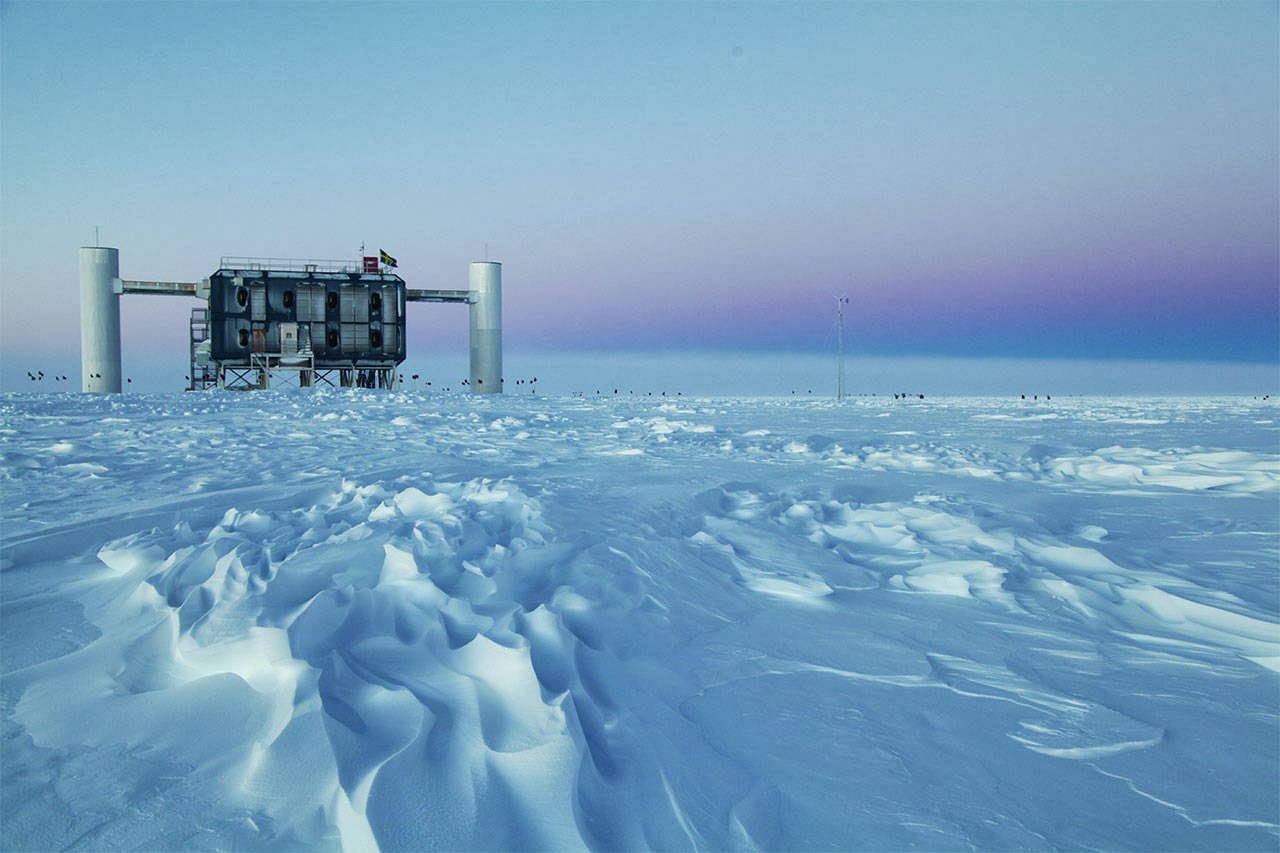
EXTRATERRESTRIAL INVADERS crash land on Earth's South Pole

No oxide, just neutrino ... The particle-catching lab in Antarctica
Dozens travelled here almost at warp speed to hit our snow slopes

Scientists at the South Pole have detected a collection of neutrinos from outer space that could help explain the origins of the universe.

A team from the IceCube telescope laboratory in Antarctica will reveal their findings in tomorrow's Science journal.

The experts believe that their 28 intergalactic subatomic particles, which were embedded within a cubic kilometre of polar ice, originated from outside the Solar System, and likely from outside our galaxy, the Milky Way.

Having identified the particles, the boffins believe that they can gain new insight into the workings of black holes, pulsars and other wonders of space that emit the subatomic particles.

The equipment is able to differentiate between neutrinos from outside the Solar System with those that may have originated from the Sun or the Earth's own atmosphere, which could reveal more about astrophysical phenomena billions of light-years from our home world. The extraterrestrial neutrinos screamed through the void almost at the speed of light before smashing in the Earth's snow.

Wednesday, July 25, 2012

Higgs: What was left unsaid

Science and techno world topic: Future, Physics.


Everybody was wowed by the recent discovery of a Higgs-like particle, but how many people really understand what was discovered.

So that’s it, search over, Higgs boson found. Almost 50 years after physicist Peter Higgs first theorised it was out there, public elementary number one has finally been captured in the data from two detectors at the Large Hadron Collider at Cern. Case closed. Champagne popped. Boson nova danced.

If only. That handily simplified and heavily fictionalised telling of the tale has helped transform a spectacular scientific success story into one that is also global front page news. Without it the 4 July announcement might not have generated such a frenzy of coverage and so many claims about it being a historic milestone for our species. One particle physicist only half jokingly told me that in future the date may come to be celebrated as Higgs Day, rather than anything to do with American independence.       

Don’t get me wrong. What has happened at Cern represents a magnificent accomplishment; big science at its biggest and boldest. And it’s fantastic that it has been perceived and received as being of such importance. It’s just that there is more to the story from the very beginning right through to the, probably false, ending. 

For starters, as Peter Higgs himself acknowledges, he was just one of several scientists who came up with the mechanism which predicted the particle which bears his name, but the others rarely get a mention*. As to the finish – well, as small children are fond of saying, are we there yet? There is very strong evidence that the LHC teams have found a new elementary particle, but while this is exciting it is far less clear that what they’ve detected is the fabled Higgs.   If it is, it seems curiously lighter than expected and more work is needed to explain away the discrepancy. If it’s not, then the experimentalists and theorists are going to be even busier trying to see if it can be shoehorned into the current Standard Model of particle physics. Either way, it’s not exactly conclusive.

Monday, July 16, 2012

Giant ice telescope hunts for dark matter's space secrets

Science and techno world topic: Physics

Scientists are using the world's biggest telescope, buried deep under the South Pole, to try to unravel the mysteries of tiny particles known as neutrinos, hoping to shed light on how the universe was made.

The mega-detector, called IceCube, took 10 years to build 2,400 meters below the Antarctic ice. At one cubic km, it is bigger than the Empire State building, the Chicago Sears Tower - now known as Willis Tower - and Shanghai's World Financial Center combined.

Designed to observe neutrinos, which are emitted by exploding stars and move close to the speed of light, the telescope is attracting new attention in the wake of last week's discovery of a particle that appears to be the Higgs boson - a basic building block of the universe.

"You hold up your finger and a hundred billion neutrinos pass through it every second from the sun," said Jenni Adams, a physicist at the University of Canterbury in New Zealand, who works on IceCube.
IceCube is essentially a string of light detectors buried in the ice through hot water drilling. When neutrinos, which are everywhere, interact in the ice, they produce charged particles that then create light, which can be detected.

Friday, July 6, 2012

Discovery of the Higgs boson


A new look at our world
Science and techno world topic: Physics

Speaking before a crowded auditorium Wednesday, July 4, the Director General of CERN Rolf Heuer has confirmed that two separate teams who worked on the Large Hadron Collider (LHC) are virtually certain to have discovered the Higgs boson, or as has been called the "God particle". Or at least, a particle entirely new exactly where we expected it to be the Higgs boson.


Picture: An artistic representation of a Higgs boson that emerges from a collision between protons.

It was the main purpose of the LHC, the giant particle accelerator built underground on the border between Switzerland and France: experimental search for traces of the particle that, according to the Standard Model of physics, explain why all objects in our universe have mass, and therefore, ultimately, the explanation why there are galaxies, planets and even humans. For this reason, the Higgs has been dubbed, somewhat 'emphatically, "the God particle." Peter Higgs, an English physicist who gave his name to the Higgs, was present at the press conference in Geneva, together with four other scientists who collaborated with him in the sixties to develop the theory. 

Saturday, June 9, 2012

Nuclear fusion

Science and techno world topic: Physics

Nuclear fusion in stars

The "nuclear fusion" also called "fusion" is the union of two light atomic nuclei to form a single heavier and more stable. During this fusion reaction, the mass of the core product is less than the sum of the masses of the light nuclei of origin. However, under the famous relationship established by Albert Einstein "E = mc2", the difference in mass is converted into energy. One can observe this particular fusion in stars in which a colossal amount of energy is released. The phenomenon of nuclear fusion is therefore different from that of nuclear fission in which a heavy atom splits into two lighter atoms with an energy release much lower.

The process of nuclear fusion can take place only under conditions of specific temperature and pressure. For example, in the heart of the sun the pressure is 200 billion times atmospheric pressure and temperature terrestrial plant reaches about 15 million degrees. Under these conditions the light nuclei of hydrogen (75% of the composition of the Sun) merged into helium nuclei (24%) approximately twice as heavy, creating light and heat we receive. According to calculations, 620 million tons of hydrogen are converted into 615.7 million tons of helium every second.


Diagnostic checks inside the experimental chamber of the prototype facility of the future Laser Megajoule © P.Stroppa / CEA


Nuclear fusion on Earth
Very large amounts of energy are released by the nuclear fusion process. Able to reproduce this phenomenon on Earth would theoretically satisfy the energy needs of permanently humanity. This is precisely the major issue of research on nuclear fusion "controlled". Fuels necessary for fusion are two isotopes of hydrogen, deuterium, available in virtually unlimited quantities in sea water, and tritium that is produced from lithium relatively abundant in the crust.
The thermonuclear bomb - commonly called H-bomb - is now the only practical application of nuclear fusion. This was tested for the first time in 1952 in the United States in the wake of the mastery of the A-bomb (nuclear fission). Thermonuclear weapons have played a key role in the deterrent balance between the two blocs during the Cold War.
Research efforts are conducted for over 50 years to recreate the conditions of nuclear fusion in a reactor. However, mastering a controlled melting process is not yet demonstrated and the technologies and materials adapted to these extreme temperatures and pressures are not yet available for industrial use. Recreate a nuclear fusion process is much more complex than exploiting the fission chain reaction.

Tuesday, May 29, 2012

Spider silk conducts heat better than metals

Science and techno world topic: Physics
Spider silk fascinated materials scientists, because they are very resistant to tearing and yet elastic.Another amazing feature of American engineers have discovered: The threads of golden silk spider conduct heat much better than most of the known materials.

"This is more surprising than spider silk is an organic material," says Wang Xinwei of the Iowa State University. The reason for the high thermal conductivity lies presumably in the structure of the silk protein from crystalline molecule blocks, which are in turn connected via flexible bridges.

Photo: Xinwei Wang Research Group

The higher the thermal conductivity of a material is, the faster heat energy can at a given temperature difference to flow through it. Pure iron as a good conductor of heat and has a value of about 80 watts per meter per degree Celsius temperature difference. Copper bumps this up to five times. The dragline silk of the golden spider on the other hand creates 416 watts per meter per degree, Wang and colleagues report in the journal "Advanced Materials".
If the silk thread drawn out, its thermal conductivity increases again by a fifth and then surpasses even that of silver. Better conductor of heat is only diamond or nanotubes of pure carbon - according to Wang's revolutionizing the new results to date views on the thermal conductivity of organic materials. May thus open up a new path, the thermal behavior of electronic components, or even to improve on clothes, said the researchers.

Research: Xiaopeng Huang, Guoqing Liu, Xinwei Wang, Department of Mechanical Engineering, Iowa State University, Ames
Publication of Advanced Materials, DOI 10.1002/adma.201104668